Growing with children: a plot or a balcony
Growing with children works best when the space is small, the crops are quick, and the child can reach everything without help. Give them a bed or a few pots of their own, sow something that comes up within a fortnight, and keep the sharp tools, the slug pellets and the poisonous plants well away from small hands. The rest is patience and a watering can.
The editors of Notes from W4 –
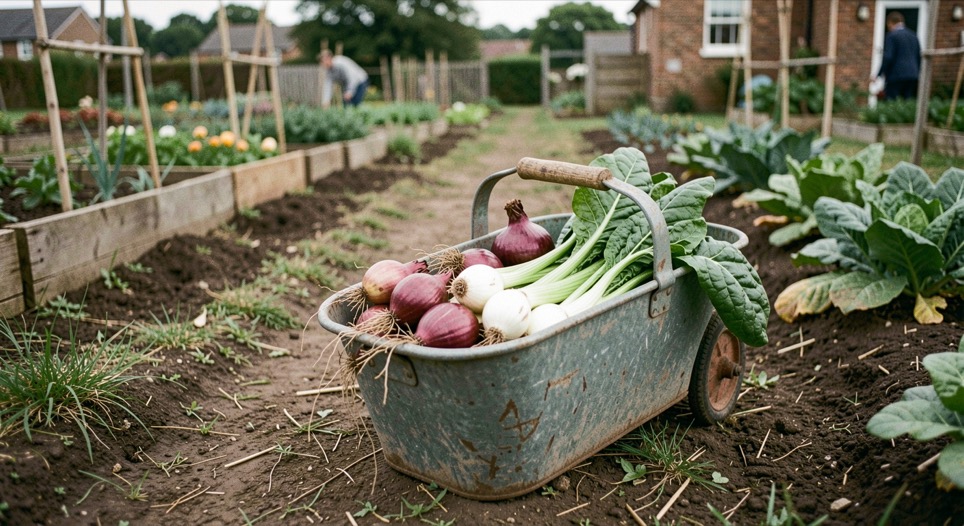
Start with a bed at their height
A child of five cannot garden in a bed built for an adult. The first job, before any seed is bought, is to make one patch that belongs to them. On an allotment this can be a strip about a metre wide and two metres long, edged with boards so it is clear where the path ends and the bed begins. On a balcony it is three or four pots along the rail, or a trough at the height of a windowsill.
The important measurement is reach. A bed wider than about sixty centimetres means a small gardener has to lean across it, and leaning across a bed is how seedlings get flattened. Keep it narrow, or give access from both sides.
Soil matters less than drainage. A bag of multipurpose compost mixed with a little garden soil will do for a first season, and it saves the child from fighting clay. If the patch is on paving, raise it: a shallow tray or a grow bag on a couple of bricks is enough. The gardening with children approach set out by The Sunflower Fort is built around exactly this scale of project, a courtyard, a balcony or a single bed rather than a whole garden.
Tools should be small and few. A hand fork, a trowel, a small watering can and a pair of gloves are enough. Anything with a long handle is for an adult to use while the child watches, and anything with a blade stays in the shed.
Which crops are quick and easy enough?
Speed is what holds a child's attention. A crop that takes four months to mature will have been forgotten long before it is ready, and a crop that fails will be blamed on the gardener rather than the weather.
Radishes are the classic first sowing. They come up in a few days and are ready in three or four weeks, and they can be sown in a pot on a windowsill in March. Salad leaves are nearly as quick and can be cut again and again, which suits a child who wants to pick something every time they visit. Spring onions, chives and parsley are reliable in pots.
For something bigger, potatoes in a sack are hard to beat. A single seed potato in a compost sack, earthed up as the shoots grow, gives a child the experience of tipping out the sack at the end and finding tubers. Runner beans and climbing French beans grow fast up a wigwam of canes, and the wigwam itself becomes a den by July. Courgettes are generous to the point of absurdity, which children find funny rather than tiresome.
What to avoid in a first year: brassicas, which need netting against pigeons and cabbage white butterflies; carrots, which need thinning and a fine seed bed; and anything that has to be transplanted twice. These are crops for a gardener who already has the habit.
Sowing in pots first, then planting out, is worth the extra step for beans and courgettes. It gives the child something to check on the windowsill every morning, and it avoids the gaps that come from sowing direct into cold soil.
What about a corner for play and making?
A child's garden is not only a vegetable patch. The space works better if part of it is deliberately given over to play and to making things, and if that part is allowed to look untidy.
A bean teepee is the standard version: six or eight canes tied at the top, with climbing beans sown at the base. It takes an afternoon to build and gives shade, a hiding place and a crop. A miniature garden in a shallow tray, planted with moss, small stones and a few alpines, occupies a child for a whole wet Saturday. Painted pots and handwritten plant labels are cheap, useful and worth doing badly.
A sand tray or a small digging area belongs near the bed, not at the far end of the garden, so that a child can move between digging and planting without an adult having to follow. A water butt with a child-height tap saves endless trips with a can, and a piece of old paving slab makes a firm surface for pots.
Keep a box of string, lolly sticks, yoghurt pots and a permanent marker near the door. Most of what a child wants to do in a garden can be done with those four things.
Which plants should be kept out of reach?
This is the part that adults get wrong most often, because the dangerous plants are frequently the ornamental ones that have been in the garden for years.
Foxgloves, laburnum, yew, monkshood, hellebore, lily of the valley and deadly nightshade are all toxic if eaten, and some are toxic on contact. Rhubarb leaves, potato foliage and tomato leaves should not be eaten either, which is worth saying out loud to a child who has watched the fruit ripen. Giant hogweed causes burns on skin in sunlight and should never be touched.
Berries are the particular risk, because a child who has been told that berries are good to eat will apply that rule to every berry in the garden. Teach the opposite rule instead: nothing goes in the mouth unless an adult has picked it and said so.
On slugs, the advice is straightforward. Slug pellets containing metaldehyde are not appropriate where young children are digging, and they are also harmful to hedgehogs and birds. Beer traps, night patrols with a torch, and a few broken eggshells or copper tape around pots will manage a small plot well enough. A pond of any size needs a rigid cover or a fence, and a water butt needs a lid.
Garden chemicals, including weedkiller, should be stored locked and out of reach, and never decanted into a drinks bottle. If a child does eat something suspect, keep the plant material and call 111 for advice.
How do you keep it going through the season?
A child's interest follows the weather and the school term, so the planting plan should be built around short bursts rather than a full year. Sow something in March on the windowsill, plant out in May, and keep a pot of quick salad going all summer so that there is always something to cut.
Watering is the job that children can genuinely own, and it is worth giving them a small can and a fixed time of day. Feeding is an adult job. Weeding is best done together, with a clear instruction about which plants are wanted, or the seedlings will go the way of the weeds.
At the end of the season, leave a few plants to go to seed. Sunflowers, nigella and poppies will come back on their own, and a child who collected the seed in September will remember the plant in April. That continuity, more than the size of the harvest, is what keeps a small plot going from one year to the next.
Small spaces reward the same approach whether a child is sowing radishes in a pot or a household is eating local from a small plot, and the wider order of sowing and harvesting is set out in growing food on a small plot.
The fruit pest a child’s apple tree will meet is covered in the RHS notes on codling moth.