Composts, fertilisers and sundries: reading the label
A bag of compost or a box of fertiliser carries a name, a volume and very little else, and most of the buying mistakes on a small plot happen at that moment of reading. This page sets out what a well-stocked horticultural store in Chiswick actually listed in 2003, how the categories differ from one another, and which bag to carry home for which job.
The editors of Notes from W4 –
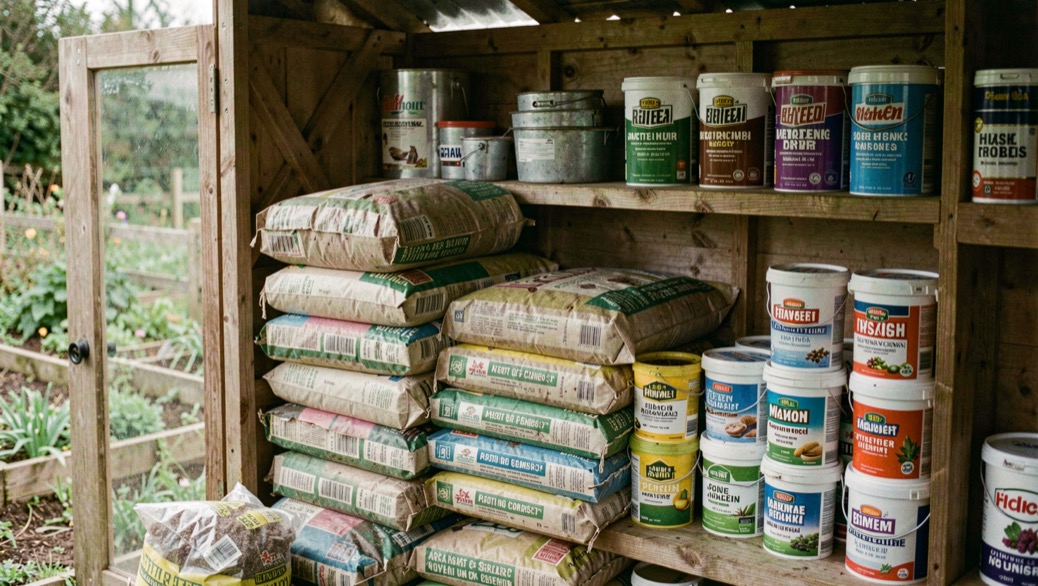
Why an old stock list still teaches
An archived trading-hut catalogue, preserved on the web archive, is one of the few documents that shows a whole range of growing supplies in a single view: bagged composts, powdered fertilisers, granules, sprays and the small hardware of pots and canes. The page archived from this Chiswick address lists them by heading, and the headings themselves are the lesson. Read them once, carefully, and the shelf of any garden store becomes ordered rather than overwhelming.
The editors reproduce no prices and no opening arrangements here; those belong to the original page and to its moment. What carries across decades is the classification and the arithmetic of bag sizes.
Compost is not one product
The list separates compost into named types, and the separation matters more than any brand. There is a general-purpose multicompost sold in 80, 40 and 20 litre bags; a horse manure compost at 70 litres; a seed and potting compost at 40 litres; and the John Innes numbers 1, 2 and 3 at 25 litres each. Beyond those sit ericaceous compost, bulb compost, house plant compost, ornamental spruce bark and bagged topsoil.
The numbers do the choosing for you. A 20 litre bag and an 80 litre bag are different jobs: the small one suits a few pots, the large one belongs to a repotting day, not to a single plant. Each named type on the list is its own compost, so the label, not the size, comes first when matching a bag to a purpose.
What counts as organic?
The archived page sets organic products apart as their own heading: a natural organic compost at 80 litres, seaweed meal, an organic lawn feed, granules and sprays labelled organic, an organic rooting powder, and organic vegetable and herb seeds alongside a concentrated chicken fertiliser in a 15 kg pack and a pelleted chicken manure. The distinction drawn on the page is one of origin, not of strength. A pelleted chicken manure is organic by source and still a concentrated feed that must be measured.
Treat the word as a category on a label, then read what the product actually contains. The archive does not state application rates, and none are invented here: rates differ between products and the packet governs.
Feeding the soil, or feeding the plant?
Fertilisers fall into two working groups on the old list. The powdered and granular sorts, blood fish and bone, sulphate of ammonia, superphosphate, sulphate of potash, are scattered on soil and work slowly through it. The liquids, including a tomato feed and a seaweed-based growth stimulant, are diluted in water and go to the plant directly. A balanced granular fertiliser appears in both forms, which tells you that balance is about the nutrient ratios, not the packaging.
The same list includes slow-release and soluble branded feeds, a rose fertiliser, a liming material and a product sold under the name Sequestrene. Each answers a specific deficiency, which is why feeding starts with a symptom, not with a calendar. If your ground is being rested or built up rather than cropped, the condition of the soil in winter comes before any bottle.
The quiet work of home-made material
Nothing in a catalogue replaces what a plot produces itself. Bagged horse manure compost at 70 litres is a purchase; the heap at the end of the plot is material you make rather than buy, and the page on heaps, trenches and what goes in sets out that arithmetic. The two trades are separate, and confusing them is how money gets wasted.
Which sprays, and against what?
The archived range divides plant protection by target: insecticides including a systemic product and a pyrethrum-based one, herbicides for paths and borders, fungicides such as Bordeaux mixture and green sulphur, and mechanical barriers such as glue bands for fruit trees. That structure is worth copying in the shed: identify the pest, then the affected plant, and only then the product. The old list is a map of approach, never a shopping instruction.
Sundries worth measuring before you buy
The hardware heading is long: nets, canes, pots and saucers in a range of sizes, seed trays, stakes, labels, marker pens, ties, garden string, and the drainage and structure materials vermiculite, perlite, silver sand, sharp sand and grit. Two of these, the two sands and the grit, are soil physics rather than convenience; perlite and vermiculite change how a mix holds water. Measure the shelf and count the pots before buying either, because the archive lists sizes but not the quantities a given plot needs.
Reading the label at the shelf
Stand at the shelf with three questions. First, what is the volume: a 25 litre bag and an 80 litre bag are different jobs, not different qualities. Second, what is the purpose written on the face: seed, potting, ericaceous, bulb. Third, what is the active material: manure, seaweed, chicken manure, or a named mineral salt. A label that answers all three plainly is the one to pick up. Note the answers in the margin of your notebook, and next season the choosing will take a minute instead of an afternoon.
Among the things a bag of compost will not put right are the beds a dog crosses and the pots a cat uses: what a pet costs a garden sets out the yearly figures.