Growing
Grow, eat, enjoy: food from a small plot
Soft fruit rewards the grower who prunes on time rather than often: raspberries, blackberries, gooseberries and currants each fruit on a different wood, and the cut that suits one ruins another. This page sets out the four treatments plainly, with the wire heights and the cuts as archived on this address, and says where the notes stop short.
The editors of Notes from W4 –
Why the wood decides the cut
The old rule behind every soft-fruit pruning note is simple: what you cut depends on how the fruit is produced, and that varies between types. Summer raspberries fruit on last year’s wood, so the canes that carried this summer’s crop are finished and are cut out at ground level after fruiting. Autumn-fruiting varieties work the other way round, producing their fruit on the current year’s growth, which is why the whole planting can be cut down in February. Confuse the two and you remove the wood that would have fed you.
Raspberries, summer then autumn
For summer varieties, the sequence is: cut out every fruited cane at ground level once picking ends, tie in the new growth, and remove any weak new canes at the same pass. In winter, take the top few inches off what remains. Autumn varieties need less thought. Their canes are cut out in February, after the October crop, and the year starts again from the ground. The archived growing notes of 2004 that carry these instructions were written for members sharing experience in the organic tradition, and the pruning page behind them deals only with established plants. It does not cover the establishment years of a new planting.
Blackberries on three wires
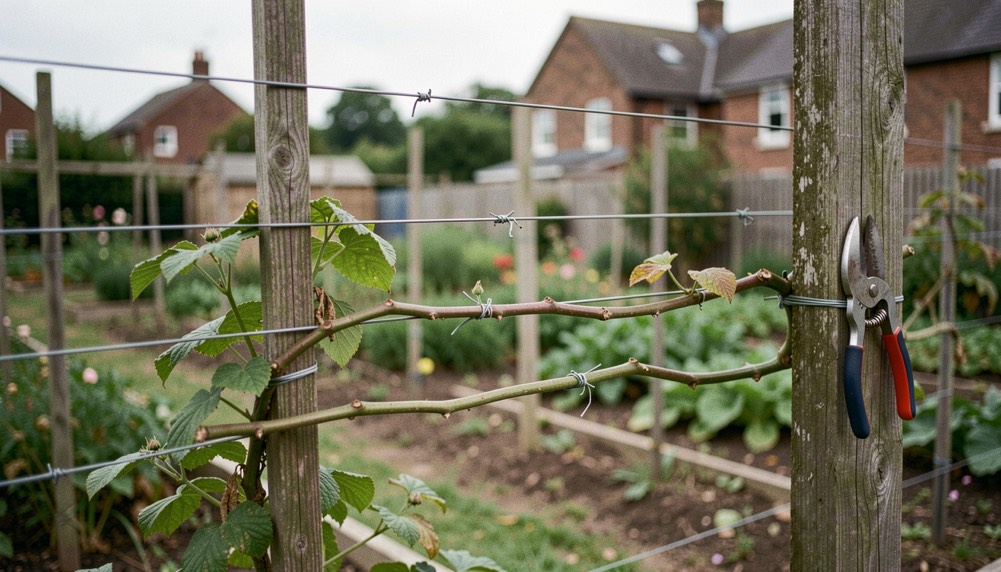
Blackberries, loganberries and their hybrids all fruit on last year’s wood. Through the season, vigorous new shoots rise from the base, and these are next year’s crop, so they are tied to the wires separately from the fruiting canes. One method given in the notes is three horizontal wires at 2.5, 4 and 5.5 feet. Fruiting canes go on the lower two; new canes run straight up to the top wire and are lowered into place once the old wood is removed in late autumn. Weak growth is cut out at ground level throughout.
Blackberries are described as the easiest soft fruit and very productive, with one reservation: they are a native and correspondingly vigorous, and left alone they take over the plot. A practical detail follows from that vigour. When removing long growth, cut it out in 2–3 ft lengths that can be removed without injury.
Gooseberries: one stem, open centre
The best gooseberry fruit forms on last year’s new growth. The bush is kept on a single stem with six to eight strong main shoots, and all suckers are removed. Side shoots are cut back to 1–2 inches; weak side shoots are removed altogether; some main shoots are cut back by half each year. The centre of the bush stays open, and branches should not cross each other.
The notes record one alternative with an honest drawback: a book of the time suggested training gooseberries as an espalier to make the fruit easier to pick. That much is true, the writer concedes, but birds find an espalier as quickly as we do, and a netted espalier was needed to get any fruit at all, while the bush form protects itself. On a small plot, that is an argument for the bush.
Red, white and black currants
Red and white currants fruit on old wood, generally at the base of side shoots. The ideal bush carries about eight main branches on a single stem. Side shoots are pruned back to a bud 1 or 2 inches from the main branch; main branches are shortened by about a quarter; a tired main branch can be replaced by a strong young growth from low down; suckers from the base are removed.
Blackcurrants are different again. Most of the fruit comes from one-year-old wood, and pruning means removing some of the oldest wood from low down, just above a strong side shoot, even at the cost of losing newer shoots higher up. As much new wood as possible should come from low down, and suckers, which are weeded out on other bushes, are encouraged here. Pruning can start as soon as the fruit is picked, though it is easier once the leaves have fallen. The full note, with its treatment of every type above, sits on our pruning page for canes and bushes.
What the old trading list tells a cook
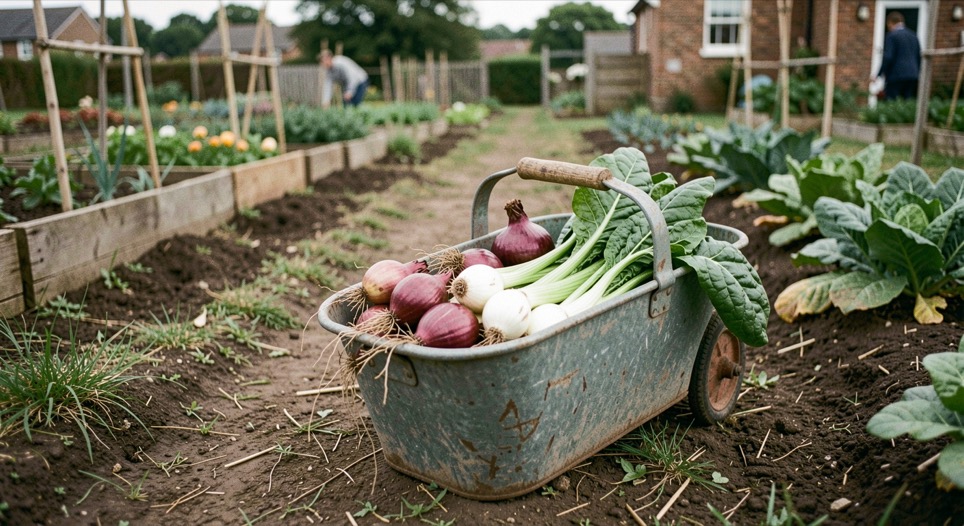
Grow, eat, enjoy is the sequence: the same archive also kept a members’ page for recipes and tips, listing French onion soup, spinach and leek pie, beans with onion and garlic, and a sarma among the dishes shared. The habit behind that page is worth copying. A small plot’s surplus arrives all at once, and a recipe kept from the year before is what turns a glut into a meal rather than a guilt.
Where does the feeding fit?
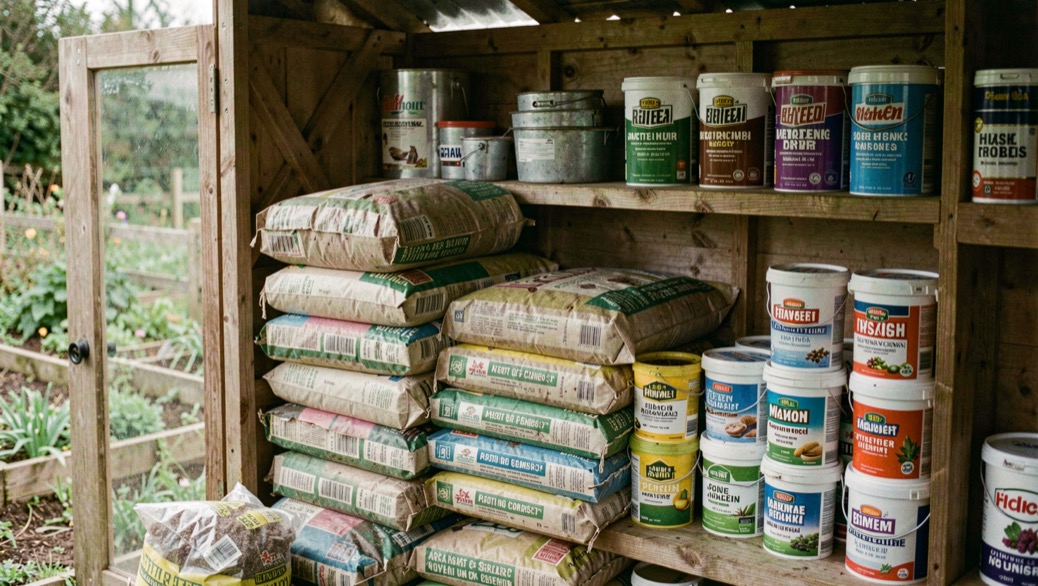
The archived trading stock of the time ran from pelleted chicken manure and seaweed meal to Blood, Fish and Bone, alongside the secateurs a pruning day needs. Labels of that kind are read the same way whichever feed you choose, and our page on composts, fertilisers and sundries shows how. Between the pruning and the feeding sits the ground itself, and the cut material can go straight to the heap rather than the bin.
A February pass, an autumn pass
Two visits cover almost all of this. In February, cut the autumn raspberries down and finish the winter tipping of the summer ones. After fruiting, and again in late autumn when the old blackberry wood comes off the wires, take out everything the notes above tell you to remove, in short lengths, and tie the new wood in while your hands are still on the wires.
Source note. web.archive.org is the Internet Archive’s stored copy of past web pages. The archived copy of the growing and cooking page was taken in February 2004, and the copy of the soft-fruit note in April 2004; both preserve the original texts, exactly as published at the time.
Much of what is written here is done at child height in gardening with children, and most of it ends in a kitchen on eating local from a small plot.