Pruning soft fruit: canes, bushes and wires
Soft fruit is pruned by one rule above all: which wood carries the fruit. Once you know whether a variety fruits on last year’s canes or on this year’s, the secateurs follow, and this page sets out the sequence for raspberries, blackberries, gooseberries and currants.
The editors of Notes from W4 –
Why the wood decides the cut
Whole books have been written on pruning, so this note keeps to a narrow question: what do you do with an established plant that is already in the ground and cropping? The purpose of pruning is to keep plants healthy and productive, and what you do depends entirely on how each fruit is produced. Raspberries, blackberries, gooseberries and currants do not all behave the same way, and a cut that suits one will ruin another. The original soft-fruit pruning note archived here makes the same point: start with the simplest treatment, learn the wood, and work outward from there. That is the sequence this page follows.
Summer raspberries: cut, then tie in
A summer raspberry fruits on last year’s wood. The arithmetic of the plant is therefore simple: once a cane has carried a crop it will not fruit again, and it is cut out at ground level after fruiting. The new growth made that season is tied in to replace it, because that is next year’s crop. Weak new growth is removed rather than tied in, since it will not pay for its space. In winter, the top few inches come off the tied canes. The winter cut is a shortening cut, not a removal: the cane stays, only its tip goes.
What about autumn raspberries?
Autumn-fruiting varieties are treated differently, and confusing the two is the commonest mistake. They fruit on the current year’s growth, reaching a crop in October, and the whole cane is cut out in February. There is no sorting of old wood from new, no separating of fruiting canes from young ones: everything comes down, and the plant starts again. If you inherit a patch and cannot tell which type you have, the month of fruiting is the tell. A raspberry cropping in October is almost certainly the autumn kind and can be cut to the ground in late winter.
Blackberries and their wires
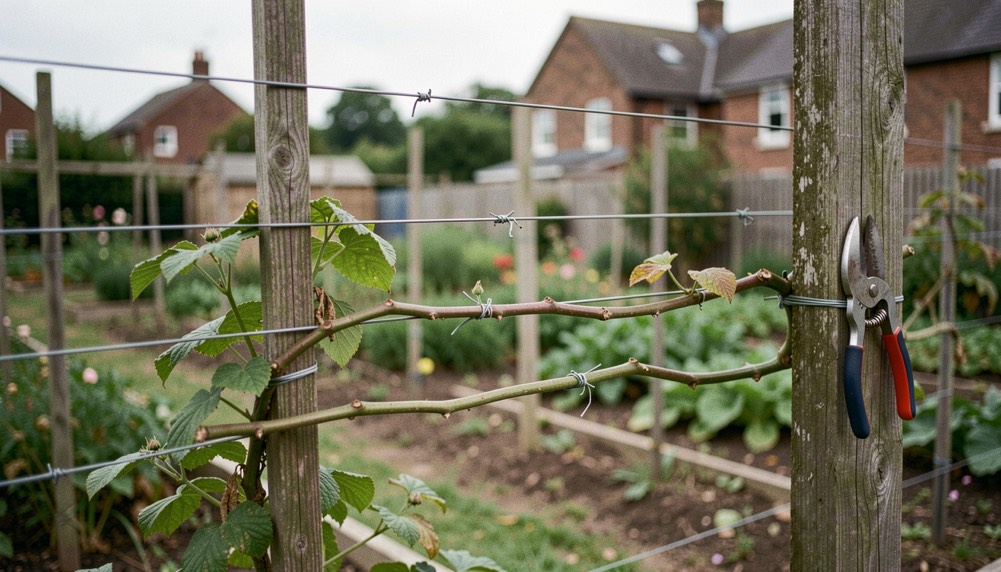
Blackberries and hybrid berries such as loganberries also fruit on last year’s wood, but they need a frame. As the season runs on, vigorous new shoots rise from the base; these will fruit the following year and must be tied to the wires separately from the canes currently fruiting. One workable arrangement uses three horizontal wires at roughly 2.5, 4 and 5.5 feet. The fruiting canes are tied to the lower two; the new canes are taken straight up to the top wire and lowered into place in late autumn, once the old fruited wood has been removed. Weak growth is taken out at ground level.
Blackberries are described in the source note as the easiest and most productive of the soft fruits, with a warning attached: they must be kept under control or they take over the plot. Being native, they are vigorous. When a long growth has to come out, cut it into sections 2 to 3 feet long so it can be carried away without injury. On a small plot, a blackberry that has swallowed its allotted corner is an expensive plant.
Gooseberries: an open bush
The best gooseberry fruit sits on last year’s new growth. The bush is grown on a single stem, carrying six to eight strong main shoots, and every sucker is removed. Side shoots are cut back to 1 or 2 inches; weak side shoots come off entirely. Some main shoots are cut back by half each year, weak shoots are removed, and the centre is kept open so that branches do not cross. One book cited in the source suggests training a gooseberry as an espalier to make picking easier, and the note concedes the point about picking while adding the counter-argument: birds find an espalier quickly, and a netted espalier against a bush that protects itself is the comparison left on record. A bush shape is the choice if birds are your neighbour.
Red and white currants, and blackcurrants?
Red and white currants fruit on old wood, generally at the base of side shoots. The bush grows on a single stem with roughly eight main branches. Side shoots are pruned back to a bud 1 or 2 inches from the main branch; main branches are shortened by about a quarter. A tired-looking main branch can be replaced by a strong young growth taken from low down, and all suckers from the base are removed.
Blackcurrants are the opposite in habit. Most of the fruit is produced on one-year-old wood, so pruning means removing some of the oldest wood from low down, cut just above a strong side shoot, even where this sacrifices newer shoots higher up. As much new wood as possible should come from low down, and suckers are encouraged rather than removed, the reverse of gooseberry treatment. Pruning can start as soon as the fruit is picked, though it is easier once the leaves have fallen.
A table for the secateurs
| Fruit | Fruiting wood | Main cut |
|---|---|---|
| Summer raspberry | Last year’s cane | Old cane out at ground level after fruiting; tip in winter |
| Autumn raspberry | Current year’s cane | Everything cut out in February |
| Blackberry, loganberry | Last year’s cane | Old wood off in late autumn; new canes lowered onto wires |
| Gooseberry | Last year’s new growth | Side shoots to 1–2 inches; centre kept open |
| Red and white currant | Old wood | Side shoots to a bud 1–2 inches out; branches shortened a quarter |
| Blackcurrant | One-year-old wood | Oldest wood out low, just above a strong side shoot |
The first cut to make this month
Walk the fruit corner with the table above and answer one question per plant: which wood is carrying the crop this season? Mark the canes or branches that have fruited, and take them out at the next dry spell. Tie in the replacements the same day, so the wind does not do the training for you. Pruning belongs with growing and eating your own food, and it is the work where a wrong cut costs a full year, so the marking comes before the cutting.
web.archive.org is the Internet Archive’s store of past web pages. It holds dated snapshots of sites that have since changed or gone, including the 2004 growing-tips page this article draws on, readable today exactly as published then.
Secateurs and canes are not the only things a garden shares with an animal: a garden animal’s first year counts the damage to beds and fences, and how to keep it down.