Hints for exhibitors: preparing produce for the bench
A produce show bench rewards preparation as much as growing. The archived exhibitors’ notes kept on this address explain which blooms to cut, how to dress each vegetable, and the small mistakes that get an entry disqualified before a judge has tasted or smelt anything.
The editors of Notes from W4 –
Grown by you, or not at all
The first rule of the bench is a rule of provenance. Every entry must have been grown by the exhibitor, from seed, bulb or similar starting point: somebody else’s plants cannot be entered under your name. There is one allowance, and it is worth knowing. A plant you bought and then grew on for at least a month counts as yours. The month is not our arithmetic; it is the figure written in the notes, and it is the honest boundary between buying a display and growing one.
Why do flowers lose on the day?
Because they were cut at the wrong hour. The advice is to pick blooms late in the evening before the show, choose ones that are fresh and only just opening so they hold through the whole day, and reject anything damaged – a brown spot or a broken tip is enough. Keep them in water in a cool place overnight, and cut some foliage from the same plant to travel with them. Where a class specifies a size of flower, the size is checked, and the count of blooms or sprays must be exact: a wrong number disqualifies the entry. Among equal blooms, the notes recommend aiming at uniformity and refinement rather than sheer size, because in close competition neatness of arrangement – “staging” – can decide the award.
Roots, tops and stalks
Vegetables come to the bench under conditions. Read the class first: if it says roots, foliage or stalks must be left on, they must be. An autumn class for runner beans asked for nine pods with stalks. If a class indicates nothing, there are no restrictions. Where more than one specimen is shown, aim for uniform size, colour and shape – three matched carrots beat one large one and two afterthoughts. Cleaning is allowed and expected: soil is sponged gently off root vegetables. The bloom on plums and other fruit is the opposite case; wipe it off and you have damaged the entry.
Five centimetres, again and again
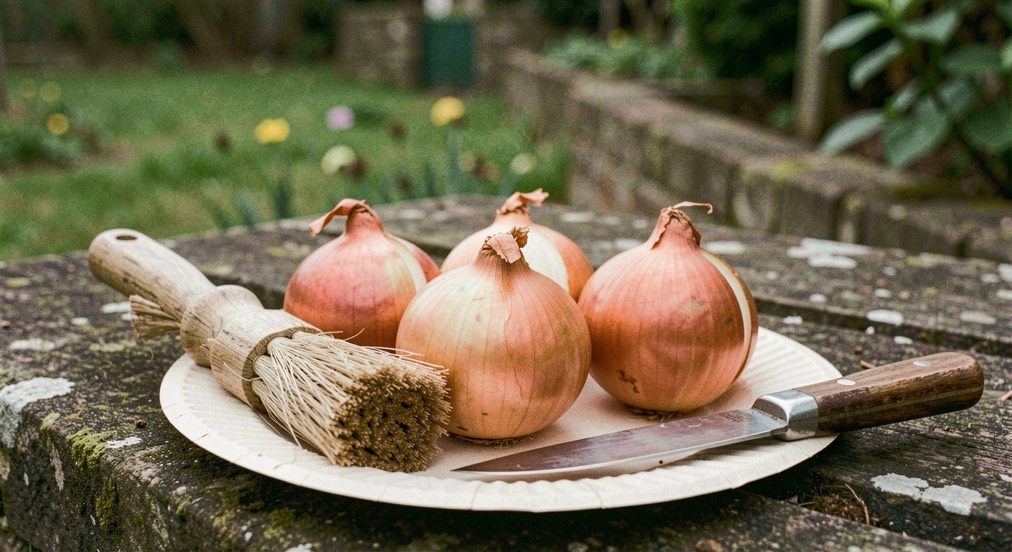
One measurement recurs through the vegetable notes, and it is worth writing on the shed wall. Carrots and parsnips have their tops removed about five centimetres above the crown. Autumn-sown onions have their tops cut to about the same length, turned over and tied, with both tops and roots left on green salad onions. Around that figure the notes build a set of exceptions: beetroot keeps most of its leaves; cabbages, cauliflowers and lettuce are shown with roots attached; and lettuce should be lifted as late as possible, because it wilts quickly on a warm day. Beans – dwarf and runner – should be long, straight and staged with stalks. Onions and shallots have their outermost skin removed one or two weeks before the show, which is what develops a good ripening colour.
| Vegetable | Preparation |
|---|---|
| Carrots, parsnips | Tops removed about 5 cm above the crown; soil sponged off |
| Autumn-sown onions | Tops cut to about 5 cm, turned over and tied |
| Green salad onions | Tops and roots both left on |
| Beetroot | Most of the leaves left on |
| Cabbages, cauliflowers, lettuce | Shown with roots attached; lettuce lifted as late as possible |
| Dwarf and runner beans | Long and straight, staged with stalks |
What about the jams?
The domestic classes are judged in the mouth and in the jar. Jams are tasted, and they are checked for correct finishing. The common failure named in the notes is a jar that has been incorrectly sealed, which leads to disqualification, so the instructions for the class should be read and followed before the fruit ever reaches the pan. The archived page does not publish recipes or quantities, and we will not invent any. Where a schedule adds a honey class, the jar is prepared and staged by the same rules; our page on showing a jar of garden honey sets out what the bench asks of it.
The hour of staging
On show day there is a set window for staging exhibits. You check in at the organisers’ table, receive an entry card, and place that card beside your exhibit – writing the variety on both sides of it if you know it, so judges and members can read it. Paper plates and three sizes of vases are provided for flowers, and the tables are marked with category numbers so exhibits sit in the right place. At the stated time exhibitors leave, the judges work, and prize-giving and collection follow. One clause closes the notes with unusual force: anything left on the tables after collection time is auctioned. A bench card, therefore, is also a deadline.
The full text, including the flower and fruit classes trimmed for the 2008 season and a class for a 500 × 500 mm display of open-grown fruit and vegetables, sits in the archived exhibitors’ page. It repays a slow read with a pencil. For how the show itself is organised around the bench, see our page on the local produce show; for the growing that gets produce to that standard on a small area, start with food from a small plot. The people who lay out the hall and take the entries are described in who does what on show day.