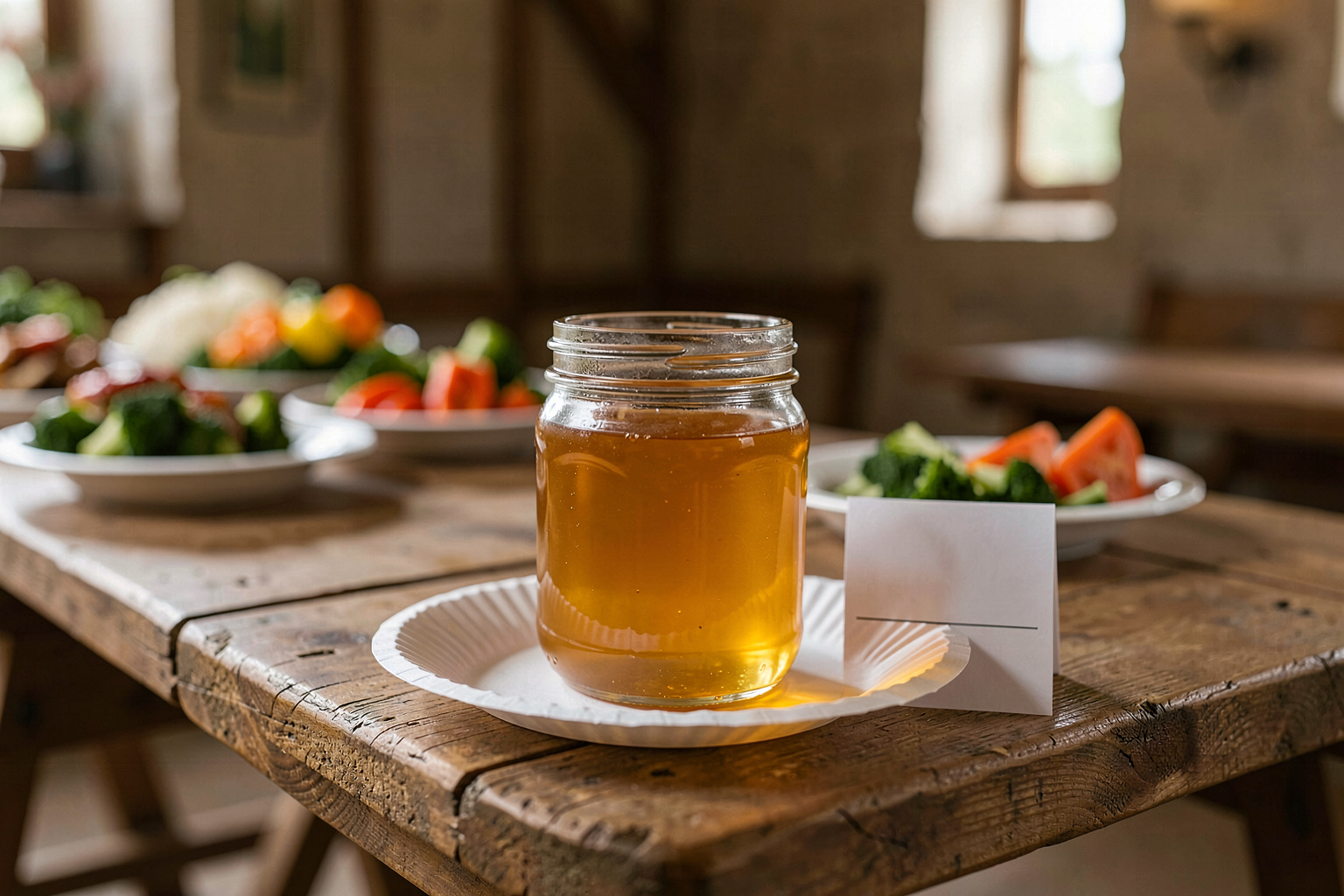
A jar of honey on the show bench: entry, staging and judging
A plot that keeps a hive produces a crop like any other, and the produce show bench is where it can be set against a standard. This page sets out what entering a jar of garden honey involves: the class definition, the state of the jar, the staging window and what the judge reads – following the show rules archived on this address, and honest about the one thing they do not preserve.
The editors of Notes from W4 –
Is honey even on the class list?
Only if the schedule says so, and that is the first check rather than an assumption. A produce show is a set of classes, each one an exact specification: nine pods, a vase, a jar. The class list preserved on this address ran to ninety-three classes in the year the archive holds, with domestic entries among them, but it does not preserve a honey class, and this page will not pretend otherwise. What it preserves is the machinery every class shares: who may enter, when staging closes, and how a prize is decided. A honey class, where a schedule offers one, runs on exactly that machinery.
Produced by you, from your own hive
The rule that governs every entry is provenance: what you show must be what you produced. The rules archived on this address put it as grown by the exhibitor, and they are not left to trust – the committee may inspect the garden or allotment of any exhibitor. For honey the reading is direct: the jar comes from your own hive, not a bought bulk re-labelled. A beekeeper who wants the longer view on that first step – where a hive should stand, what a colony needs through the seasons – will find the harvest itself, from capping to extraction, set out month by month in Embâchileve, a French magazine for garden beekeepers. The bench judges the jar in front of it; the keeping that produced the jar happens years earlier.
From capped comb to a clean jar
Between the hive and the hall sits the preparation, and it is mostly restraint. The honey must be ripe when taken – capped over in the comb – or it carries too much water and can ferment in the jar. It is then extracted, strained to clear it of wax and debris, and left to settle so air bubbles rise out before jarring. The jar itself is checked against the class: some schedules ask for a specific size or a matching pair, some for clear honey and others for granulated or heather. A jar filled short, a lid smeared with honey, or a label the class did not ask for are the unforced errors that cost an entry before it is ever tasted. None of this is exotic; it is the same attention the vegetable classes demand of a plate of matched carrots.
What does the judge actually look at?
At the jar first, and at the honey second. The visible faults are the ones a judge can see without opening anything: specks of wax or dust in suspension, a ring of froth at the shoulder, a fill line that does not meet what the class states. Then the honey itself: brightness and clarity where the class is for clear honey, an even set where it is for granulated, and aroma when the lid comes off. The schedule defines which of these the class is about, which is why the exhibitors’ habit archived on this address – read the class first, then prepare – is the whole of the method. Britain also runs dedicated honey shows with their own class lists, and their standards are stricter in detail, but the order of faults is the same a village bench applies.
Staging follows the clock, not the judge
Once the jar is ready, the rules take over. Entries cannot be accepted or altered after five o’clock on the day before the show, and anything not staged by the stated time is refused. At staging you collect the entry card and place it face down beside the exhibit; only judges and officials stay in the hall while judging runs. The full wording sits in the show rules archived on this address, and our page on how a local produce show works sets out the same machinery from the hall side. A jar that misses the window is not judged at all, however good the honey inside it.
And after the prizes?
The bench has an ending written into it. Exhibits wait at the exhibitor’s own risk, are collected at the stated time, and anything left on the tables after collection is auctioned – the clause is in the archived rules and it closes the day. A honey that does not place is still a jar of honey, and a judge’s mark is a reading of one entry on one day, not a verdict on a hive. The same reading habit that gets a jar onto the bench is set out for vegetables and flowers on our page of preparation hints for exhibitors, and it is the habit that matters more than the card.