Waterlogging on a plot: soil or drainage?
Water that stands on a plot after rain is usually telling you something about the ground beneath it, not about the digging. Before lifting a fork, watch where the water sits, how long it takes to go, and whether it returns in dry spells. If it drains away within a day or two of rain stopping, the soil is probably fine and the plot is simply low; if it lingers for a week or backs up after every shower, the outlet is the place to look, and the same logic applies to a blocked gully or chamber as it does to drain unblocking in Chiclana, where the first job is always to find out which part of the system is failing before anything is opened.
The editors of Notes from W4 –
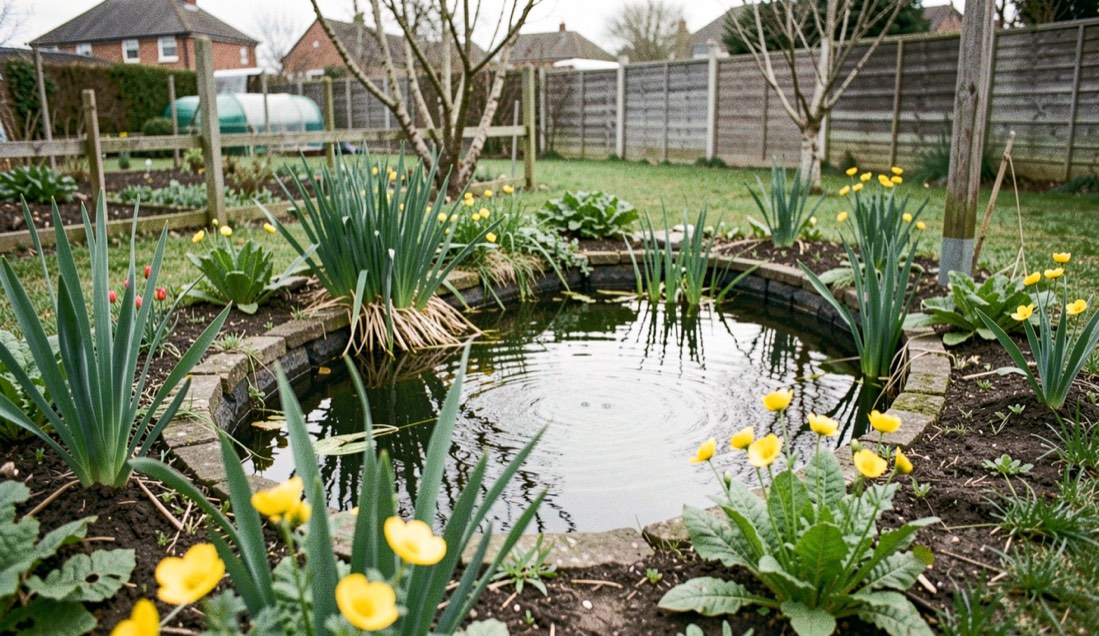
Watch the water before you dig
A fork turned into saturated clay makes a worse mess than the water did. Compaction from walking and digging on wet ground squeezes the pore spaces that let water move, and a plot can be puddled for a season on the strength of one afternoon's work. The practical order is observation first: mark the edge of the puddle with a cane, note the time, and check it the next morning. Water that has dropped several centimetres overnight is moving; water at the same level after two dry days is not.
Look also at the shape of the ground. A dip in the middle of a plot collects water from every side, and no amount of organic matter will lift it. A slight fall towards a hedge or a ditch usually means the water has somewhere to go and only needs a clear route. Where the plot sits below the level of the surrounding road or path, rain running off hard surfaces can arrive faster than the soil can take it, and the puddle is a symptom of run-off rather than of a bad subsoil.
Is it the soil or the drainage?
These two problems look alike and are treated differently. A soil problem shows itself evenly: the whole plot is slow after rain, the subsoil is grey and sticky a spade's depth down, and there is no single low point where water gathers. A drainage problem is local. Water appears in one line or one corner, often above a pipe run, a soakaway or an old land drain, and it may smell faintly or carry a film on the surface.
A simple test is a hole about 60 cm deep, filled with water and left overnight. If the hole is empty by morning, the subsoil is draining and the trouble is at the surface or in the outlet. If it is still full, the ground itself is the limit, and the answer is raised beds, ridges and organic matter rather than pipes. On heavy London clay, the second result is common and is not a fault to be fixed.
Where does the water actually go?
Every plot has an outlet, even if nobody has looked at it for years. On an allotment it is often a grid at the low corner, a chamber under a paving slab, or a length of pipe running to a ditch or a surface-water sewer. Water standing above a grid means the grid is doing its job and the pipe beyond it is not. Water standing with no grid in sight means the outlet is somewhere else, and the first task is to find it.
Lift the cover, if there is one, and look before reaching. A chamber that is full to the rim is holding water that should have left; a chamber that is dry while the plot floods is not connected to the flooded area at all. Note the direction of the pipe runs, the number of inlets, and whether any of them is running while the rest are still. That record is what a contractor needs, and it saves a return visit.
Clearing a grid or a chamber without making it worse
Work from the top down. Rake leaves, grass cuttings and silt off the grid first, because most blockages at a plot are at the surface, not in the pipe. A grid set in a low corner collects everything the plot sheds, and a mat of roots and moss across it is enough to hold back a considerable volume.
If the grid is clear and the water still stands, the obstruction is downstream. Rods or a drain snake can be fed from the grid, but only if the chamber is safe to open: never lift a cover where water may be in contact with electrics, and never enter a chamber. A chamber is a confined space, and the gases in a foul system can be lethal within seconds. For a plot, the sensible limit is surface clearing, gentle rodding from an open grid, and a note of what happened.
Do not pour chemicals into a plot drain. Caustic products damage pipe joints, kill the soil life around a soakaway, and give no useful information about where the blockage sits. A bucket of water tipped into the grid is a better diagnostic: if it disappears, the pipe is open and the problem is upstream; if it stands, the pipe is blocked and the next step is a camera or a jetting hose, which is a job for equipment and, in most cases, for someone insured to use it.
When to stop and call someone
Stop when the water is rising rather than falling, when it is backing up into a building, when the chamber is full and the cause is not visible from the surface, or when the flooding follows every rainfall regardless of what is done at the grid. Stop also when the outlet is shared: on an allotment site or a communal garden, a blockage in a shared run is a matter for the site rather than for one plot, and one tenant rodding a shared pipe can push the problem into a neighbour's ground.
A professional visit at that point is about inspection and decision, not about muscle. The useful sequence is to open and prepare the access points, run a camera along the run, test the joints for tightness, and locate any leak or hidden chamber before choosing between a local repair, a replacement length, or a trenchless method that avoids lifting the whole path. The same order applies to the maintenance side: emptying a tank, an aljibe or a septic pit, cleaning and disinfecting it, keeping a record of each visit, and disposing of the sludge through a licensed route rather than on the plot.
What to record for the next time
Keep a small plan of the plot with the grid, the chamber, the pipe runs and the direction of fall marked on it. Add the date of each flood, the depth of water, the time it took to clear, and what was done. Two seasons of that record will show whether the problem is seasonal, structural or simply a matter of the plot sitting in a hollow, and it turns a vague complaint into a brief that anyone can act on.
For the ground itself, the long answer is organic matter, raised beds on the wettest strip, and a permanent path so that the beds are not walked on when wet. For the outlet, the answer is a clear grid, an accessible chamber, and a decision made on evidence rather than on hope. Water that leaves a plot within a day is a working plot, whatever the soil underneath is made of.
Water is a question of quantity either way: the wet end of a plot is covered in pond and bog planting, and the opposite problem is set out in planting for a dry summer.
Rainfall records for the area are kept by the Met Office.