Gardening where winter is long and water counts
On a mountain or plateau plot, the growing season is short and the water you have is the water you store. Plan the garden around access first, then shelter, then water, and treat every plant as a gamble against a late frost. The soil can be improved in a season; a blocked track or an empty tank cannot be fixed in a week.
The editors of Notes from W4 –
Start with the track, not the beds
Before deciding where the beds go, walk the route a delivery or a wheelbarrow would take in February. On a slope, the steepest section is usually the one that ices first and thaws last, and that is the section that decides whether you can reach the plot at all. A guide to mountain property and rural systems such as rural mountain property sets out the same order of questions for buyers: winter access before signature, snow clearing, driveway gradients, escape routes and distance to services. The gardening version is smaller but identical in shape. If the track needs a vehicle to bring in manure or compost, its condition in January is a design constraint, not an inconvenience.
A few practical consequences follow. Keep the compost heap and the water tank on the side of the plot you can reach on foot when the track is closed. Put the tool store near the house rather than at the far end. If the only flat ground is beside the entrance, that is where the raised beds belong, even if the view is better higher up. On a plateau the wind is the other half of the access problem: a gate that faces the prevailing wind will drift shut, and a path across open ground will lose its surface to scouring.
How do you garden when the season is short?
The short answer is to work with a smaller number of crops and give them better conditions, rather than trying to grow everything and losing half of it. A mountain season of perhaps a hundred frost-free days rewards earliness and hardiness over variety.
Choose crops that tolerate cold nights: brassicas, roots, broad beans, chard, salad leaves, and potatoes in bags that can be moved under cover. Use transplants rather than direct sowing for anything tender, so the plants spend their early weeks somewhere warm. Cloches, fleece and a cold frame extend the shoulders of the season more reliably than a heated greenhouse, which needs power and attention in weather that often prevents both.
Succession sowing matters more here than in a mild garden. Sow small quantities every three weeks from early spring, because a single sowing lost to a late frost leaves a gap that cannot be filled later. Keep a note of the last frost date you actually observe, not the one on a seed packet, and adjust each year. Soil temperature is the better guide for germination; a cheap probe is worth more than a calendar.
Finally, accept that some years will be poor. A wet, cold June will cost you the courgettes whatever you do. The garden that survives is the one with a reserve: a few plants under cover, a store of roots, and a plan for the year when the outdoor crop fails.
Water: store it, cover it, and know what you have
On a plateau or a mountain plot, water is rarely a matter of turning a tap. Mains supply may be absent or distant, and a well or spring may be the only source. Store water high if you can, so gravity does the work, and keep the tank shaded and covered to limit algae and evaporation. A covered tank also keeps out leaves, which otherwise rot and clog the outlet.
Work out your daily need honestly, including livestock, and then multiply by the length of the dry spell you might face. Roof catchment is the usual answer for garden water: a metal roof sheds cleanly and quickly, and a first-flush diverter keeps the worst of the dust and bird droppings out of the tank. If the plot relies on a well, the yield matters more than the depth, and the seasonal low point is the figure to plan around. In Colorado, water rights and well yield are legal as well as practical questions, and the same caution applies anywhere that abstraction is regulated.
Irrigation should be aimed at the root zone, not the foliage. Drip lines under mulch lose far less to wind and evaporation than overhead watering, and they can be run from a header tank on a timer or simply by hand. Mulch heavily: straw, woodchip or gravel, depending on the crop. On exposed ground, a bare soil surface will dry out within hours of a windy day.
Wind, snow and the shape of the plot
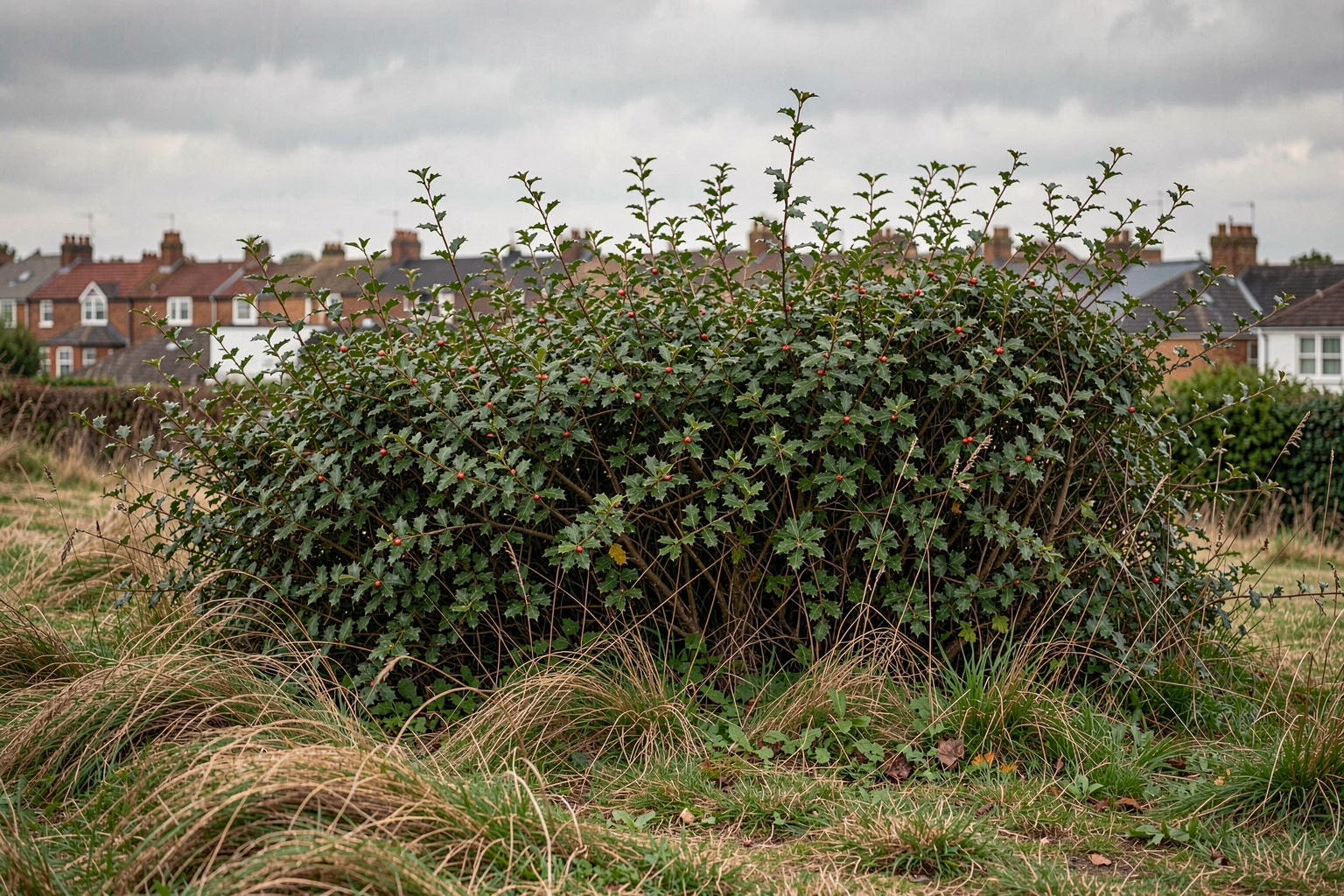
Wind does more damage on a mountain plot than cold alone. It strips moisture from leaves, snaps tall plants, and scours snow off the ground so that soil freezes deeper. A windbreak of native hedging, planted on the prevailing wind side, will change the microclimate of the whole garden. The rule of thumb is that a permeable barrier protects a distance of roughly ten to fifteen times its height downwind, so even a low hedge of two metres is worth having.
Do not plant a solid wall of evergreens. A dense barrier creates turbulence on its lee side and can dump snow in a drift across the beds. A mixed hedge, with some deciduous species, filters the wind instead. Cut it in late winter, before birds nest, and keep the base wide.
Snow is an asset as well as an obstacle. It insulates the soil and protects overwintering roots, so leave it where it lies on beds and around fruit bushes. Clear it only from paths and from the roof edge where it might slide onto a doorway. Where snow slides off a metal roof, keep beds and water butts out of the fall zone; a roof shed can bury a young tree in seconds.
What about sun, slope and frost pockets?
Orientation decides how much warmth a plot receives and where cold air collects. In the northern hemisphere, a south-facing slope gains heat early and holds it late, which is why terraces and raised beds on a south aspect are worth the effort of building. A north-facing slope will be colder and slower, and should be given over to crops that do not mind.
Cold air behaves like water: it flows downhill and pools in hollows. A plot at the bottom of a slope, or behind a solid barrier, will be a frost pocket, and the lowest corner will be the coldest part of the garden. Put tender crops higher up and hardy ones in the hollow. A gap in a hedge, left deliberately at the lowest point, lets cold air drain away instead of collecting.
Solar gain can be captured with simple structures: a south-facing wall, a stone or concrete path that stores heat, a cold frame angled towards the sun. Thermal mass helps most when it is inside the protected space, not outside it. In practice, a bed against a south wall of the house or shed will give you two or three weeks of extra season at each end, which is often the difference between a crop and a failure.
The soil, and the patience it needs
Mountain and plateau soils are often thin, stony and acidic, and they warm slowly. Do not try to dig the whole plot in the first year. Build raised beds with imported topsoil and compost, and improve the ground beneath them over time. Organic matter does two jobs here: it holds water in a dry spell and improves drainage in a wet one.
Test the pH before adding lime, because mountain soils vary enormously over short distances. Keep a compost system that works in cold conditions: a covered bin or a trench, rather than an open heap that freezes solid in January. Leaf mould is slow but excellent, and leaves are usually abundant.
Above all, keep records. Note the date of the last spring frost, the first autumn one, the day the tank runs low, and the direction of the damaging wind. After three or four years the pattern becomes clear, and the garden can be designed around it rather than against it.
Shelter, water and a short season are read together in planting for a dry summer, and the woody planting that holds a windy site is described in native trees and shrubs.
Fruit problems in a cold, wet garden are described in the RHS notes on pear rust.