Native hedging: species, spacing and cutting
A native hedge is a working piece of structure, not a decoration: this page sets out the species mix, the 30-centimetre spacing, the double row and the half-and-half cutting cycle that the planting plan archived on this address spells out. The arithmetic is simple, and so is the reason behind every figure.
The editors of Notes from W4 –
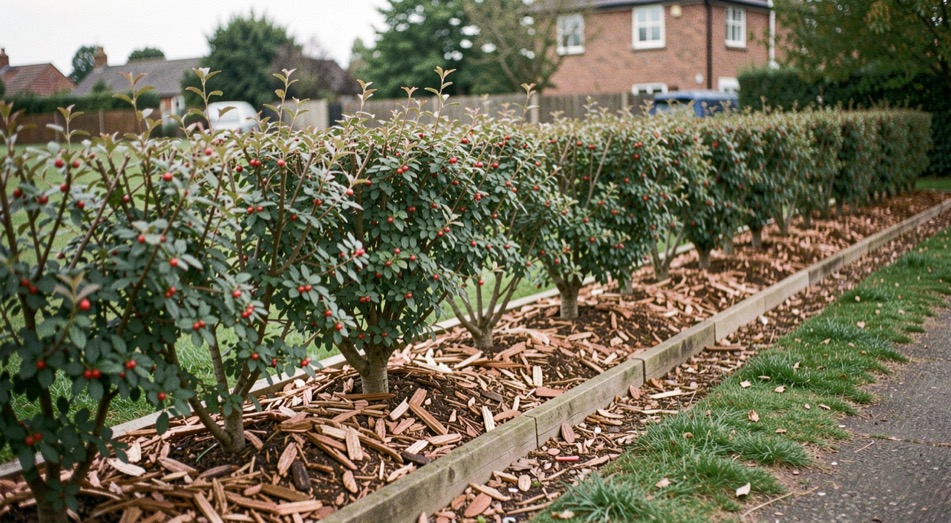
Why a hedge wants to be mixed
A hedge made of one species is a line of identical plants. The archived planting list on this address does not describe one: it sets proportions, and it names eleven species before it names a single spacing. The planting plan archived here takes the opposite route. It names a core of hawthorn, crab apple and common buckthorn, holding those at 80 to 90 per cent of the whole, and then lets a longer list fill the remaining 10 to 20 per cent: field maple, hazel, spindle, wild privet, wayfaring tree and guelder rose. The effect is a hedge that flowers and fruits across a longer season, because the parts are not in step with each other.
The two plants that hold their leaves
Beech and holly are listed separately, for winter foliage. Beech keeps its dead leaves through the cold months, so a beech-heavy stretch gives cover when the rest of the line is bare. Holly is evergreen and carries berries, and the plan carries one instruction with it that is easy to miss: one male plant for every six females. Count your plants before you order, not after.
Five plants to the metre
The spacing is the part worth writing down. Seedlings of two years are planted in a double row for extra density, at 30-centimetre spacing, which works out at five plants per metre of hedge. They also go in 30 centimetres back from any surrounding fence, so the hedge has room to thicken on both faces without fighting the boundary. Five plants per metre sounds generous until you stand at the fence with a tape and mark it out.
Planting is followed by watering in and mulching, and then by watering through the whole first year. That first-year watering is the difference between a hedge that establishes and one that sits still. After that, the plan turns to what goes underneath: woodland bulbs and flowers, planted at the base, which is a subject with its own page on underplanting beneath hedges and trees.
How much do you cut each year?
Half of it. The maintenance line in the plan says to cut back half every year, so that cover is always left for birds and insects. This is not tidiness; it is a rotation. One half of the growth is kept in leaf and berry while the other half regrows, and the two halves swap roles the following year. The plan also sets a target height of 1.6 metres as the minimum. Anything lower and the hedge stops being a hedge and becomes a low shrub line, which is a different thing for both shelter and nesting.
What happens after ten years?
The plan gives the hedge a decade, then a choice: lay it or coppice it. Laying is the traditional craft of cutting partway through the stems and bending them along the line, which keeps the base dense and the hedge alive. Coppicing means cutting hard to the stump and letting it regrow from there, which resets the plant but removes all cover for a season. Which of the two suits a small plot depends on how much shelter the hedge is being asked to give and when, and the plan does not say more than that. It is the one decision in the whole scheme that is left to the grower.
| Share of hedge | Species |
|---|---|
| 80–90 per cent | Crataegus monogyna (hawthorn), Malus sylvestris (crab apple), Rhamnus cathartica (common buckthorn) |
| 10–20 per cent | Acer campestre (field maple), Corylus avellana (hazel), Euonymus europaeus (spindle), Ligustrum vulgare (wild privet), Viburnum lantana (wayfaring tree), Viburnum opulus (guelder rose) |
| Winter foliage | Fagus sylvatica (beech), Ilex aquifolium (holly, one male per six females) |
The climbers that belong in it
A hedge is also a trellis, if you let it be. The plan lists three climbers to run through the line: honeysuckle (Lonicera periclymenum), old man’s beard (Clematis vitalba, also called traveller’s joy) and bittersweet (Solanum dulcamara). All three flower. They add a layer of blossom at the top of the hedge where the shrubs thin out. If the hedge runs beside the boundary of a planned wildlife corner, the climbers are the cheapest way to make the whole edge work harder.
Counting the order
Everything above reduces to one list and one sum. Measure the run of hedge in metres, multiply by five, and that is your plant count before any allowance for losses. Split it: 80 to 90 per cent across hawthorn, crab apple and buckthorn; the rest across the six minor species; beech and holly only where winter cover matters. Mark the double row at 30 centimetres from the fence, water through the first year, cut half each year, and diarise year ten. The plan archived on this address gives no figure for losses, no supplier and no price; those you will have to find for yourself, and rules differ between sites on what a boundary hedge may contain. And where the line must stand in a prevailing wind or in salt carried off the sea, the exposure questions come before the spade – the same species list read against a harder station.
A hedge that has to hold a windy, snowbound site is chosen on a hedge for a mountain plot, where shelter matters more than ornament.