The meadow: grasses first, flowers after
A meadow on a small plot is mostly grass, and the grasses decide the look of it long before any flower opens. The planting plan archived on this address in 2004 names three grasses and about thirty flowers, marks nine of the flowers as specially recommended, and says the meadow is to be sown or plug planted and mown at the end of summer.
The editors of Notes from W4 –
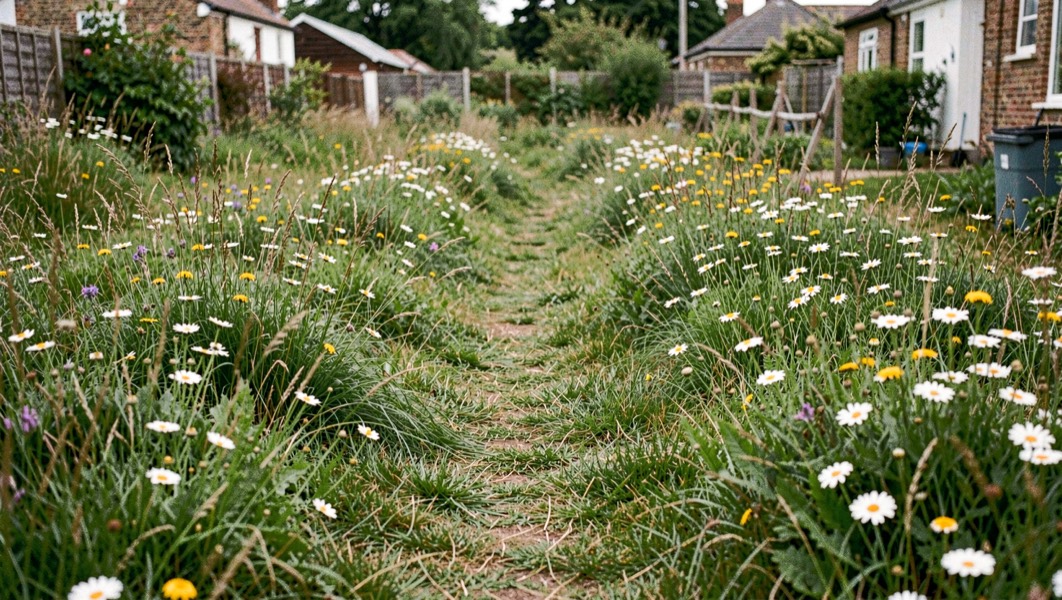
Three grasses, and why they come first
The plan lists three meadow grasses: Agrostis tenuis (common bent), Festuca rubra (red fescue) and Poa pratense (smooth meadow grass). That is the whole grass list, and it is short on purpose. Bent and fescue are fine-leaved and low in growth, which is what lets the flowers be seen at all. A coarse, lush grass would shade them out and take the nitrogen before they could. The flowers are chosen on the same principle: most of them are plants that hold their own in thin, dry, unfed ground.
This is the opposite of the logic that governs a vegetable bed, where feeding is the point. The two logics can share a plot, but not the same patch of soil.
What “specially recommended” means here
Nine flowers in the list carry an asterisk, the plan’s mark for a plant it specially recommends: Centaurea cyanus (cornflower), Centaurea nigra (common knapweed), Daucus carota (wild carrot), Galium verum (lady’s bedstraw), Geranium pratense (meadow cranesbill), Knautia arvensis (field scabious), Papaver rhoeas (poppy), Plantago media (hoary plantain) and Rumex acetosa (common sorrel). The plan does not say why these nine and not the others, so we will not invent reasons. What can be said from the list itself is that the nine span the whole season, from the annual poppy to the perennial knapweed, and that the yellow of lady’s bedstraw and sorrel sits against the blues of the cornflower and cranesbill.
Annuals, biennials, perennials: the key to the list
The list carries a key: a for annual, b for biennial, r for rhizome or bulb, p for perennial. It is worth reading before buying anything, because the key tells you when to expect each flower and what to expect of the first year.
| Life form | Examples from the list | First flowers |
|---|---|---|
| Annual (a) | Papaver rhoeas, Centaurea cyanus, Anchusa arvensis | The year of sowing |
| Biennial (b) | Dipsacus fullanum, Verbascum thapsus, Campanula rotundifolia | The second year |
| Perennial (p) | Prunella vulgaris, Primula veris, Origanum vulgare | Established plants, then yearly |
The annuals give the first summer its colour and then rely on the mowing to set seed again. The perennials are slow to start and are the meadow’s long-term stock. A list like this one is built so that the plot does not look empty while the perennials are still putting down roots.
Which flowers, and in what company?
Beyond the nine starred plants, the list includes Achillea ptarmica (sneezewort), Alchemilla xanthochlora (lady’s mantle), Aquilegia vulgaris (columbine), Campanula glomerata (clustered bellflower), Echium vulgare (viper’s bugloss), Verbascum nigrum (dark mullein), Viola tricolor (heartsease) and Viola canina (heath dog violet), among others. The full list, with every name and every key letter, is on the archived meadow planting page, and it is worth reading whole before ordering seed. Two entries on it stand out as unusual for a meadow: Narcissus lobularis, the native daffodil, which flowers before the grass gets going, and Viola odorata, the sweet violet, which the plan notes was available from a named supplier. The plan does not give quantities, proportions or a spacing for any of these, and we do not supply figures it omits.
Sowing or plug planting?
The plan allows both: “initially plants to be sown or plug planted”. It does not say which suits which species, and the choice is a real one. Annuals take readily from seed sown where they are to grow. The perennials and biennials are slower, and plugs, small established plants set into the sward, shorten the wait by a season. A reasonable reading of a mixed list like this is seed for the annuals and plugs for anything marked b or p, but that is our reading of the list, not a rule the plan states.
One mowing, at the end of summer
The plan gives the meadow one instruction for aftercare: mow at the end of summer. The wider wildlife plot plan archived on the same address adds one detail, a mown path cut through the meadow for access, in contrast with the mature dry meadow either side of it. That is the whole of the stated management, and it is deliberately little. An early cut would remove the seed heads the annuals need; frequent cuts would turn the meadow back into lawn. One cut, late, and the seed has already fallen.
The same plan restricts the whole plot to native species, cultivated organically, and puts the meadow beside a pond and a boggy area planted to Caltha palustris and Lythrum salicaria; the wet end of the plot is described elsewhere in this notebook, as is the native hedge that shelters it. A strip of knapweed and scabious is also where a beekeeper’s jar begins; the bench that jar can be taken to has its own page.
Where this meadow sits on the plot
The plan draws the meadow as part of a working wildlife plot, not as an ornament: paths of log slices on bark chippings, a hedgehog shelter under existing brambles, a hide with viewing slots. The meadow earns its place by being the part that needs least labour once it is in. Everything else on the plot asks for attention through the season; the meadow asks for one afternoon with a mower after the seed has set, and gives the dry stems and the path through them the rest of the year.
What the archived pages do not settle is how long a list this size takes to settle into a stable sward, or how the proportion of grasses to flowers drifts after the first few mowings. That is measured plot by plot, and the plan, rightly, stops where the facts stop.
web.archive.org is the Internet Archive’s wayback machine. It stores snapshots of web pages taken over the years and serves them free at their original addresses. The meadow planting list and the wildlife plot plan quoted here are two such snapshots, captured in 2004.
A meadow is not the only sowing done at a smaller scale: a child’s first bed is prepared the same way, and planting for a dry summer applies the same reading to ground that never gets enough rain.