Underplanting beneath hedges and trees
Twelve species are enough to turn the dry ground under a hedge into a layer of flowers that asks for nothing once it is settled. This page sets out that list, notes which plants return each year and which do not, and shows where the ground beneath trees needs a different approach from the hedge base.
The editors of Notes from W4 –
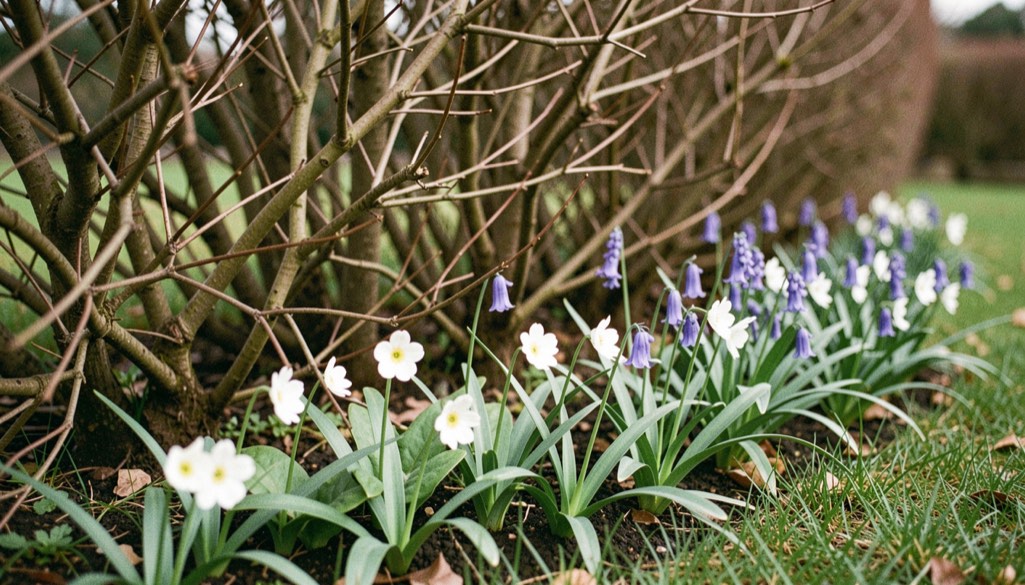
A hedge that ends at the stem
A native hedge planted at five plants per metre gives cover, berries and a cutting rhythm, and the notes on hedging species and spacing say exactly how it is put in. What a hedge does not do by itself is fill the strip of ground at its feet. That strip is dry, shaded for part of the day, and full of roots. Left bare it grows annual weeds; planted, it can hold a second layer of growth that flowers earlier than anything above it. The wildlife allotment plan kept on this address treats that strip as a planting bed in its own right, with its own species list and its own key.
The key before the list
The list is read against a four-letter key: a for annual, b for biennial, r for rhizome or bulb, p for perennial. The key matters more than it looks, because it tells you what the ground will be doing in year three. A bed built mostly on perennials and bulbs thickens on its own; a bed with annuals in it needs the annuals to seed themselves, which means leaving the seed heads on and tolerating a scruffier June. Both kinds appear on the plan’s list, so the bed is designed to be half-managed and half-self-sowing rather than fully planted every year.
Which plants carry the bed?
Five entries are marked perennial: Anemone nemorosa (wood anemone), Fragaria vesca (wild strawberry), Lamium album (white dead-nettle), Primula vulgaris (primrose) and, among the unmarked but reliably perennial in behaviour, Ajuga reptans (bugle). The bulb and rhizome group carries the spring: Hyacinthoides non-scripta (bluebell), which the plan flags as native and not Spanish, and Anemone nemorosa again. The bluebell warning is written in the plan itself, and it is worth repeating here: the native and the Spanish bluebell are separate things, and the list wants the native. Digitalis purpurea (foxglove) is the one biennial, flowering in its second year and then relying on seed.
What fills the gaps by itself?
The unmarked species are the self-seeders and colonisers: Arum maculatum (lords and ladies), Chelidonium majus (greater celandine), Geranium robertianum (herb-robert), Silene dioica (red campion) and Viola riviniana (common dog violet). These are the plants that will move. Herb-robert will find any gap at the hedge edge; red campion will drift along the line over a few seasons. The practical consequence is that the original planting is a starting position, not a fixed pattern, and the way to keep the mix is to let the perennials hold the ground and thin the colonisers when they crowd.
Beneath trees, the same idea with less water
Under trees the competition is harder, because the tree roots take water before the flowers do. The plan gives tree species and spacing on its trees and shrubs page, and it applies the same underplanting list beneath both trees and hedges rather than writing a separate one. That is a choice worth noticing: the list is woodland-edge material, wood anemone, bluebell, primrose, and it is being used wherever the conditions imitate a wood edge. The plan does not give a spacing for the underplanting, so the distances are left to the planter; bulbs and rhizomes go in at whatever density the stock allows, and the perennials are spaced so they meet within two seasons. The shelter this shade depends on is itself a decision on open ground: the line that stands in wind and salt is chosen before anything is planted beneath it.
The hide, and what grows over it
The plan’s hide is an open-sided shed with cut-out viewing slots, and the underplanting page gives it a single instruction: to be covered in climbers, with Hedera (ivy) named as the example. Ivy is the only climber on this page, though the hedging page adds Lonicera periclymenum (honeysuckle), Clematis vitalba (old man’s beard, traveller’s joy) and Solanum dulcamara (bittersweet) running through the hedge itself. The hide therefore does not depend on the flower list at all; it depends on one evergreen climber doing the covering while the flowers work at ground level around it.
Where the list stops
Twelve species, one key, one climber and one warning about bluebells: that is the whole of the archived page, and it is enough to plant from. What it does not settle is proportion. The plan says nothing about how many of each species per metre of hedge, so a bed drawn from this list is a matter of judgment at planting time, thickened afterwards by whatever seeds itself. The full list as originally published, with the key and the entries in order, is on the archived underplanting page.
The archive itself
web.archive.org is the Internet Archive’s public store of past web pages. This article draws on copies of pages kept there from a planting plan published on this address in 2004. The copies preserve the species lists, the keys and the planting instructions as they stood, and they can be read there in full.
Nothing here needs a large garden, which is the argument of food from a small urban space, written for pots, balconies and shared plots.